
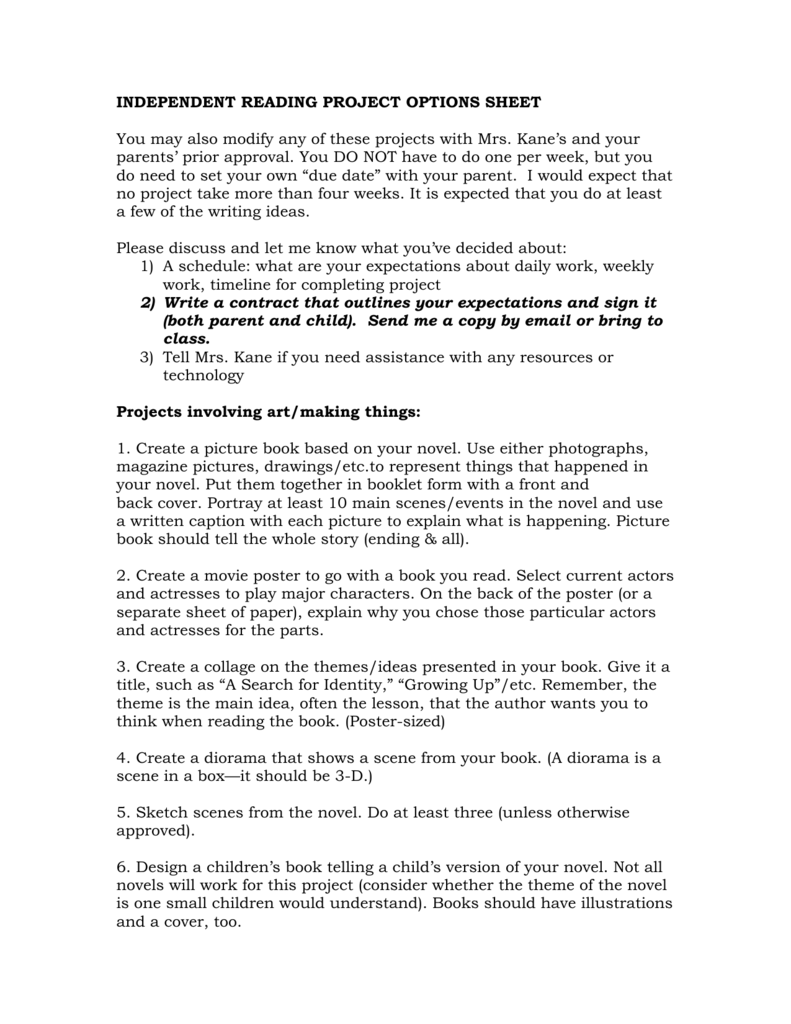
The Independent Reading Project is meant to help you improve your reading and critical thinking skills by giving you a chance to read a book of your own choice and provide your own analysis of the text. Independent Reading Project Select a book that you have not read before, and that is at your reading level. Read the book and fill out the reading log. Choose a project from the 'Pick your Project Paper'. Independent reading should be grounded in student choice, but without support in the process of selecting books, students can easily flounder. Regie Routman outlines key characteristics of scaffolded independent reading, including 'Student chooses any book to read with teacher's guidance' and 'Student reads ‘just-right' books.'
http://www.readwritethink.org/classroom-resources/lesson-plans/developing-reading-plans-support-836.html
Contribute to ReadWriteThink / RSS / FAQs / Site Demonstrations / Contact Us / About Us
ReadWriteThink couldn't publish all of this great content without literacy experts to write and review for us. If you've got lessons plans, videos, activities, or other ideas you'd like to contribute, we'd love to hear from you.
Find the latest in professional publications, learn new techniques and strategies, and find out how you can connect with other literacy professionals.
Teacher Resources by Grade
| Kindergarten | ||
|---|---|---|
| 1st - 2nd | 3rd - 4th | |
| 5th - 6th | 7th - 8th | |
| 9th - 10th | 11th - 12th | |
Your students can save their work with Student Interactives.
Home › Classroom Resources › Lesson Plans
Lesson Plan
E-mail / Share / Print This Page / Print All Materials (Note: Handouts must be printed separately)
DIGG
STUMBLEUPON
Independent Reading Project High School
DEL.ICIO.US
NEWSVINE
Independent Reading Projects For Elementary Students
| Grades | 6 – 8 |
| Lesson Plan Type | Standard Lesson |
| Estimated Time | Three 50-minute sessions |
| Lesson Author | Blacksburg, Virginia |
| Publisher |
| Preview | Standards | Resources & Preparation | Instructional Plan | Related Resources | Comments |
OVERVIEW
In this lesson, students brainstorm texts that they have read recently and map their choices using a Graphic Map to rate and make notes about them. Students then look for patterns connecting the texts that they enjoyed the most and those they enjoyed the least. Once they've analyzed their past readings, students complete a reading plan by first listing categories of books they want to read. They then use booklists, book reviews, and other resources to create a wish list of books they hope to read in the future.
FEATURED RESOURCES
Graphic Map: Students can use this online tool to visually organize books they have read.
FROM THEORY TO PRACTICE
One of the greatest challenges of an independent reading program is keeping students reading. Katz et. al (2005) explain the predicament teachers frequently face:
'They are frustrated when students linger aimlessly at the bookshelf or book bins. They lose patience when a student finishes one book and loudly proclaims, I'm done. I need another book.' Teachers find themselves becoming reading police, observing their students to catch someone who is not reading. And students don't seem to be accountable for their time, causing some parents and administrators to challenge teachers by suggesting that the students are just sitting there reading' (1)
Independent reading should be grounded in student choice, but without support in the process of selecting books, students can easily flounder. Regie Routman outlines key characteristics of scaffolded independent reading, including 'Student chooses any book to read with teacher's guidance' and 'Student reads just-right' books.' (85). By having students create reading plans, teachers can provide students with the guidance they need, pointing students toward the 'just-right' books, as Routman suggests, and challenging them to try new genres and authors.
Further Reading
Katz, Claudia Anne, with Laura Polkoff and Debra Gurvitz. 'Shhh . . . I'm Reading': Scaffolded Independent-Level Reading.' School Talk 10.2 (January 2005): 1-3.
Routman, Regie. 2003. Reading Essentials: The Specifics You Need to Teach Reading Well. Portsmouth, NH: Heinemann.